AI Has Made Marketing Too Easy (Or, If You Ask Me, Harder)
Founders are shaping their brand from day one, through every name they pick, every word they write, every choice they make, whether they call it marketing or not (most don’t!). All that execution is faster and cheaper than ever, and that, oddly enough, is exactly the problem.
Founder time is the most valuable and finite resource you have in an early-stage company. It compounds on vision, on relationships, on the decisions only you can make, and the one place it never compounds is production. More specifically, the brand choices you’re making right now, often without realizing at all, are quietly turning into a bill that comes due later. I call it strategic debt, and this piece is about what it really costs you, and what to do instead.
Because opinions should come with context, here’s some background on me: I’ve been in marketing since 2018. My first foray was building a vegan and gluten-free brand in Mexico. Then moved across the world to study luxury marketing in Paris, where nothing is left to chance and the attention to detail is astronomical. Now I work in the MARCOM team at Breega, a VC fund. In tech, what I do under “brand marketing” is basically a bit of SPAM (social, PR, advertising, marketing), TODÓLOGA in Spanish, events included, and every one of those skills lives inside marketing, so going deep on it is my job. Going that deep on brand while you’re also writing the code for a fintech, though? Hmm. Part of my role is working directly with early-stage founders to shape their brand with strategy and longevity in mind rather than by what “looked good,” and what I’ve seen is consistent enough to call a pattern and give you my thoughts on.
The thing with most early-stage brands is, you never really decide on most of your brand. It accumulates, one small unexamined choice at a time, and everything that piles up that way, without anyone actually choosing it, is exactly what comes back to cost you later.
What a brand actually is (because most people using the word aren’t talking about the same thing). A noteworthy distinction: branding and marketing are related, but they’re not the same. If branding is who you are, marketing is how you reach people. Everything in marketing feeds off the brand, which is why the two get confused, and also why it has to be solid before you get into bed with AI.
A brand has three layers:
- verbal (your name, your copy, your tone)
- visual (logo, color, typography)
- and experiential (how people actually feel when they interact with you, from the first email to the renewal conversation).
All three are amplifying a message whether you mean them to or not. The brand isn’t the logo, the logo’s just a byproduct. What makes people remember a brand is whether all three layers agree with each other, and whether they keep agreeing over time.
Take Who Gives A Crap. It sells toilet paper, one of the most absent-minded purchases there is, and it makes people actually care: the name, the voice, the mission, the tone of every line of packaging copy, it builds a relationship the product alone never could. People subscribe, they advocate, they give it as a gift, and remember, this is toilet paper. That’s the brand doing the heavy lifting, not the product.
Tropicana went the other way. In 2009 it redesigned its packaging to look “more modern,” dropped the iconic orange-with-a-straw, and watched sales fall 20% in two months, around $30 million, before it quietly reversed the whole thing. It was the same juice inside, the only thing that had changed was the brand, and that by itself was enough to do the damage. Brand is a business asset, and it moves revenue in either direction faster than most founders expect.
Building a brand takes time, and it needs a clear division of labor that almost nobody draws correctly. So when a founder says “I handle our marketing,” the real question is: which part? The scope of what you just claimed is enormous. Marketing is never one job. It’s positioning, content, social, PR, events, email, SEO, the website, even the wording of a job ad.
Knowing where you should focus your time and resources makes for a better outcome:
- The brief belongs to you (founder): the core narrative, your non-negotiables, and the enemy you define yourself against.
- The execution belongs to a professional: copy, design, positioning language.
- The veto belongs to you, but with a defined scope and process. (See the Direction Scorecard template in the Founder’s Brand Guide)
When you collapse all three into yourself, you skip the middle one and end up with execution built on your taste and whatever time you had that week, not on strategy.
Saying you can handle your own brand because you’ve got Canva and a ChatGPT account is like saying you can do HR because you once hired someone. You filled a role. That doesn’t mean you understood the skills it needed, the culture fit, or the long-term cost of getting it wrong.
Delegation is a skill in its own right, one that good founders either have or have to grow into. Brand is usually where it gets tested first, because it feels personal and it feels doable. The uncomfortable part is sitting with work that doesn’t look exactly like the version in your head. That’s where most founders quietly take the work back, but learning to stay with it is what actually lets the company grow beyond just you.
Strategic Debt is the bill nobody signs off on.
Founders understand technical debt intuitively. You take a shortcut in the codebase to move fast, someone flags it, it sits in a backlog, everyone knows it’s there. Strategic debt works the same way, except it stays invisible and nobody can name it. Every implicit brand decision, the casual tone of the first ten emails, the landing page template someone picked because they liked it, the purple logo because it “felt trustworthy,” compounds quietly. Strategic debt doesn’t surface until you try to scale, and by the time you notice, you’re staring at a repositioning, a rebrand brief, confused sales pitches, and misaligned hires. A proper rebrand at Series A and beyond runs from €80k up depending on scope, and that bill almost always traces back to a set of decisions nobody consciously made. That’s the day an agency sits across from you and explains that the identity won’t hold up in a regulated market, that the tone you’ve been using is quietly pushing away the exact buyers you’re now chasing, and that every deck, case study and post you’ve ever shipped is now either wrong or off-brand. Nobody put that on an invoice up until that point, and you’re going to end up paying for it.
This is why, before you produce anything, you want a Minimum Viable Brand. Not a full identity system, not a thirty-page guidelines doc, just enough of a foundation that everything you put out points the same way and a professional can build from it later without demolishing what’s there. A name, a logo, a palette chosen on purpose, a tone of voice actually written down somewhere, a core message that doesn’t move every quarter. (There’s a fill-in-the-blank workshop template on how to build your MVB in the Founder’s Brand Guide that comes with this article.)
I watched this with a deeptech company we backed at pre-seed. Before they even had a full product, we built an MVB: a logo, an icon, a palette, a documented tone of voice, an email signature, a LinkedIn banner. The point wasn’t to get it perfect, the point was to build a good foundation to take a first step out into the world and stop there. A year later they did a full agency rebrand, guess what… something was kept: the icon/symbol from the MVB (with a new look), but it was still there! Why? Because the early thinking was solid enough to build on. Many things changed, because a pre-seed company and a Series-A/B company with a live product, clients, and a stronger positioning have more needs. That is what intentional early brand work does. It does not prevent you from evolving. On the contrary! It gives you something worth evolving from.
If you have made it this far, you already know the brand is not the main priority for most pre-seed and seed B2B tech companies (because it will most likely change later), and that is fine. But there is a difference between not prioritizing it and completely overlooking it. Taking a few days (ideally over a week to let ideas sit) to get the direction right saves you from inheriting a mess when it actually matters.
Across stages, what changes is which mistake actually costs you. At pre-seed, the only expensive mistakes are the ones you cannot undo cheaply: a name that will not clear trademark or travel across markets, a category you accidentally box yourself into. Everything else can be scrappy. At seed, the risk becomes legibility, whether an early customer or a candidate understands what you do in one read. By Series A the problem turns internal: you are hiring people who each interpret the brand their own way, and investors are underwriting whether you can own a category, so a fuzzy position reads as a fuzzy strategy. If you end up repositioning during the raise itself, that is strategic debt coming due, and the question worth bringing into the round is why nobody caught it sooner.
Now add AI to that picture. McKinsey estimated in April 2026 that agentic AI could power up to two-thirds of current marketing activities, and that while nearly 90% of CMOs are experimenting with AI, fewer than 10% have captured value across end-to-end marketing workflows. The gap between experimenting and getting value isn’t a tool problem. It’s a foundation problem.
Force multipliers don’t discriminate. If your positioning is unclear, AI will reinforce that unclear positioning faster and at higher volume. If your tone of voice is all over the place, AI will spread that across ten channels instead of two. The companies getting burned by AI in marketing aren’t using bad tools, they’re using good tools on weak foundations, and the speed just makes the problem harder to catch before it’s everywhere.
Your brand is not a prompt! Everyone leans on the same tools, everyone is producing the same AI-shaped content, the same sentence structures, the same paragraph rhythms, the same ChatGPT cadence. You know the ones: “Not because you forgot to erase the invisible space. But because of the Short. Punchy. Words. In. Every. Single. Line.” It feels dynamic and says nothing. You can spot it from a mile away, and so can your audience, even if they can’t name it yet.
A lazy prompt or a fancy one still gives you something generic if the human thinking isn’t there first. Newsflash: a founder’s taste isn’t a strategy either. Strategy is a choice made with your audience and your goals in mind. Without a process, preference wins by default, usually yours, and nobody notices because it was never a fully conscious decision. The fix is a process, scoring your options against the goals you actually want to hit, which is exactly what the scorecard in the brand guide is for.
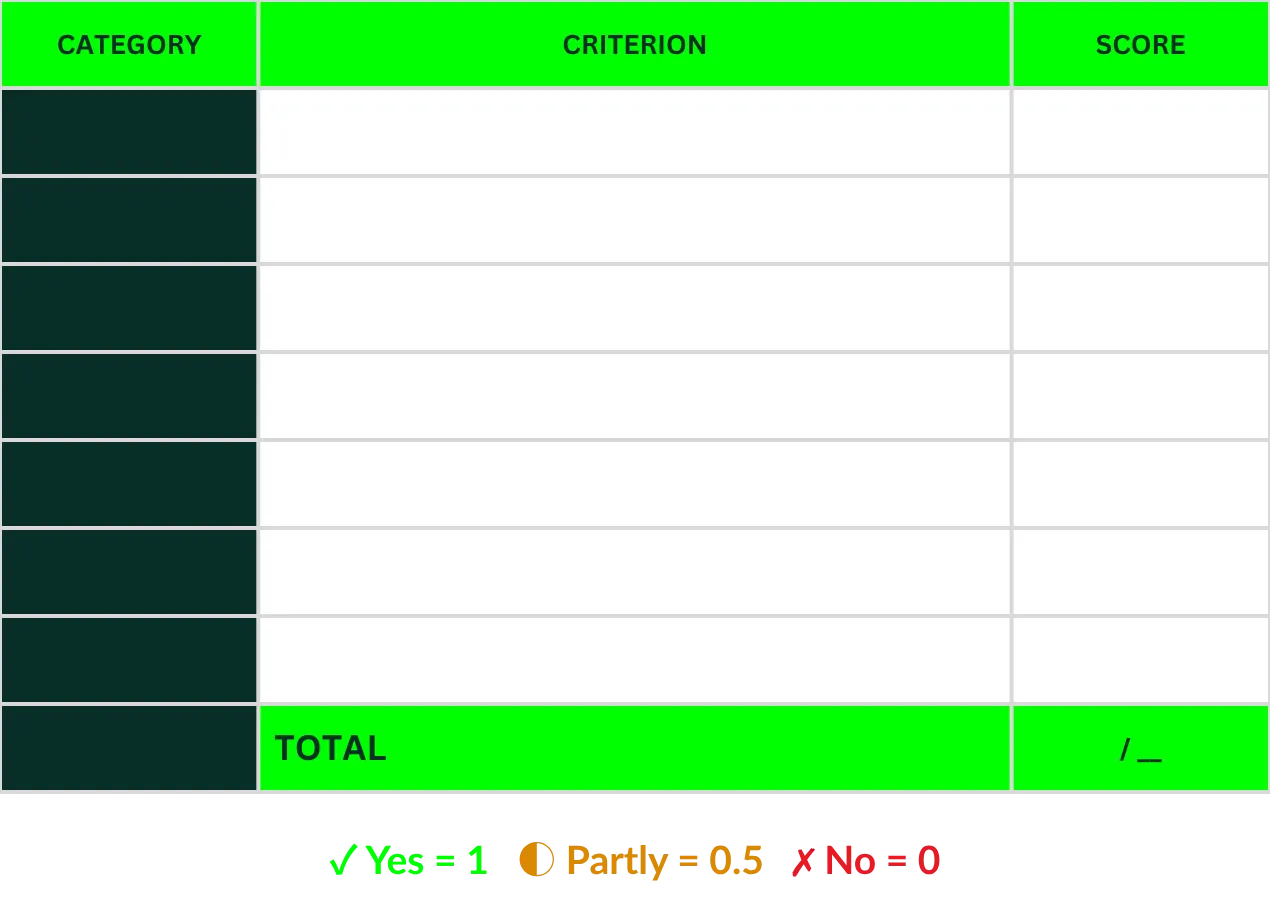
Hell, I’d be less worried watching a founder print the templates, order a pizza, and pull an all-nighter trying to crack their positioning than watching one hand the whole thing to ChatGPT and call it done. At least the first one is doing some contextual thinking about a market or industry they hopefully know back-to-front.
The better use of AI, especially early, is diagnostic. Before it makes anything, put it to work stress-testing what you already have: find the inconsistencies, simulate your target audience, feed it your last five pieces of content and ask what story they tell about the company. The answers won’t always be sharp, but they’ll surface things you stopped seeing because you’re too close.
The simplest version of that test needs no AI at all: read everything you’ve put out as if you were a stranger, and ask one question. If that’s all someone saw, what would they conclude about you?
Generating or creating (assets/copy) should be the last step, not the first. Which is why you want one brand source of truth: a doc, a Notion page, a data lake, whatever, so the website, the deck, social, PR and emails stop telling slightly different stories. Point your shared agent or skills at that, trained on your actual brand docs, and it beats everyone spinning up their own version of who you are. That’s where AI really earns its place as you grow: it scales your foundations (cracks and all), so what you feed it had better be worth scaling.
And to be clear, I genuinely love AI and use it every single day: I’ve built a site for wmbltech with a flow that auto-matches teammates in less than 48 hrs, a multicurrency personal finance app on Lovable (I looovvveeee Lovable), and “understood” code (sort of) just by asking. It’s a great tool, and it’ll ship you a slick website in minutes, which is exactly when most founders mistake having a presence for having a position. Because a website is just a container, just another page on the internet. What goes in it, who it’s for, why it’s different, how it sells, THAT’S MARKETING.
AI builds the shelf, it doesn’t stock it (said ChatGPT).
And there’s a cost to doing all that execution yourself that never shows up on an invoice. While you’re busy prompting a new deck or website, someone else is talking to your next customer. You’re tweaking the same prompt for the fifth time? A competitor is closing a partnership. And while you’re regenerating the logo one more time, or asking for yet another color combination, your product is waiting. It’s paid in the hours you didn’t spend on the things only you can do. Nobody else can sell your vision to an investor. Nobody else can make the product call that changes the roadmap.
And the irony is that all that time rarely buys you anything distinctive. Your website says “AI-powered solutions” and so does every other competitor. What makes a brand stand out is clarity, and clarity takes time. Simply put: you should be executing something else.
What does community have to do with all of this? Maybelle Morgan wrote in Dazed that inconvenience is the cost of community. She was writing about culture and belonging, but it maps directly. The things that build a real community around a company, showing up consistently with an actual point of view, taking positions that might lose some people, being specific enough that the right audience recognizes itself, are inconvenient. They take judgment and time. And they’re the difference between an audience and a community. An audience watches. A community shows up, defends you, brings others in, and sticks around when things get hard. The difference is almost always how clear you are about what you stand for, and that clarity is your brand doing its job.
For first-time founders this is easy to underestimate, because community looks like something you earn once you’re big enough. It’s the opposite. Community is what you build on the way up, and it only compounds if the brand underneath it is worth belonging to.
Brand Marketing Is a Sales Function, and it should be treated as such.
Judge every brand and marketing activity by one question: does this drive sales, directly or through the conditions that make sales possible? That includes brand, community, events, thought leadership, PR. If you can’t explain how an activity connects to revenue, top of funnel or further down, you should probably stop doing it. Brand equity is real. It runs on a longer timeline than a sales cycle, but it is still a precondition for revenue. Posting every day is not marketing. Having a monthly newsletter is not marketing. Those are activities. Marketing is what happens when those activities are designed well enough and used consistently enough to actually change what someone does.
And done right, it compounds, because eventually everyone loves a winner. You can’t picture LimeWire’s logo. But you can picture Spotify’s exactly, because Spotify won that race.
The founders who get this right aren’t the ones who do everything. They’re the ones who know what they’re building, who they’re building it for, and who to trust with the parts that aren’t theirs to own. They protect their time for the calls that are genuinely theirs, and brief other people clearly enough to handle the rest. They stay close to the strategy without colonizing the execution.
AI is more of an editorial board than a content farm, useful only once you’ve got something worth saying. It doesn’t sit at the table during lunch. It can’t hear the tone in someone’s voice when they talk about what they’re building, or feel the passion of a founder who’s poured everything into what they’re showing you. Marketing is strategy, but it’s also psychology, the selling, the connection, the experience.
David Brooks wrote in The Atlantic a couple months ago that when intelligence is plentiful, volition is valuable. As AI takes over more of the execution, the work that stays human is judgment, taste, brand integrity, and the relationships it can’t automate. The trend to watch isn’t which tools are most capable. It’s the widening gap between the companies built on a clear foundation and the ones that aren’t.
Building a company is already one of the hardest things you can do. You don’t have to do the brand and marketing alone, and you were never supposed to. Treat the shortcuts for what they are: debt you pay back with interest. The question was never whether you can do it yourself. It’s whether you should.
→ Full Founder’s Brand Guide HERE
Sources
- “What to Learn From Tropicana’s Packaging Redesign Failure?”, The Branding Journal, 2015.
- “Reinventing marketing workflows with agentic AI”, McKinsey & Company, April 2026.
- “The People Who Will Thrive in the AI Age”, David Brooks, The Atlantic, June 2026.
- “Is inconvenience the cost of community?”, Maybelle Morgan, Dazed, October 2025.


