Master the Mechanics of Governance That Works: Inside the Excom.
Inside the Excom.
Allow us to use an analogy that might resonate with you: the couple and the ExCom, same challenge.
“We need to spend more time together,.”
“We should establish rituals to communicate better.”
When things escalate, if trust is broken, it’s hard to have difficult conversations.
So, how do we address this?
The ExCom must work on its two pillars to achieve its goals: discipline and trust.
Before diving into how to work on these aspects, here’s a more detailed recap of the ExCom’s role, the why behind its existence:
The executive committee is a body that makes decisions and provides recommendations on overall strategy and operations. It also serves as an information forum and a platform for discussion:
- Prepare the overall strategic action plan, as well as financial and non-financial goals.
- Implement the vision, core values, strategic priorities, and medium- and long-term plans and decisions.
- Oversee the execution of decisions made by the board of directors by setting OKRs and executing recruitment and team development plans (= guidance and recommendations on any organizational structure changes, on any major operational or business issues likely to impact results).
- Company preservation: monitor and control performance (against the BP, budget, and identify/explain discrepancies, act on investments, expenses, and OPEX revisions).
- Ensure compliance with regulatory and legal requirements and internal policies (legal, fiduciary, reputational, etc.).
- CSR/ESG: Key principles and objectives must be specified, with regular quarterly follow-ups on actions taken and an annual review for the entire team.
To delve further into the how to effectively work on these exciting topics, let’s focus on Discipline and Trust.
1. Discipline
Who is in the ExCom?
When setting up a ExCom, you must think with a three-year horizon in mind and ensure that:
- The key functions are represented.
- The members of the ExCom have sufficient empowerment to make decisions and drive the company’s growth.
You must be attentive to who joins the ExCom, as if some members are not up to the requirements (skills, experience, potential, and values), it would send a weak signal to the entire company, while destabilizing the ExCom, which must be a STRONG and STABLE body.
Everyone brings intrinsic strengths and areas of genius.
Structure and rituals
For an ExCom meeting to be effective, the agenda must be defined and sent in advance. The ExCom needs preparation!
There must be “Minutes of Meeting,” which are sent to everyone at the end of the meeting to track progress and refer back to in the next meeting (otherwise, no follow-up!).
❌ An ExCom meeting/ritual is not 3 hours a week (see SteerCo).
Here are some suggestions:
- 1 half-day per month to dive deep into topics!
- 1 Slack/Teams channel (or other software) to update asynchronously or ask daily questions.
- 2 ExCom-building sessions per year (minimum 2 days) to step back from the company, continue strengthening the team (and if needed, bring in an external coach or facilitator).
- Ad-hoc meetings if urgent matters need to be addressed.
Not to mention punctuality and attendance (for video meetings: camera on, for example).
👉 2 Takeaways:
- Assign roles: an agenda holder, a timekeeper, a decision pusher (these roles can rotate).
- Close laptops (for those not taking notes or presenting) and put phones on “do not disturb.”
Compensation
There must be consistency in the compensation of ExCom members, and there can be no negotiations leading to favoritism or exceptional benefits. If there are differences in compensation, these should be justified by objective criteria related to experience or skills (for fixed compensation) and performance (for variable compensation).
Discernment and pragmatism
A ExCom member must not take things personally. They must be able to “kill” their own job: it’s about the company’s interest, not the individual. This is discipline! The manager protects and grows their teams. The ExCom member protects and grows the company. When navigating difficult situations, they don’t choose one or the other; it’s the logic of “AND” rather than “OR.”
2. Posture (the human element)
As mentioned above, being part of the ExCom requires maturity and the ability to take a step back, and to dare to question your own job, your own results, with vulnerability: challenging! This ExCom posture, which must be developed, enables the ultimate success factor for theExCom: being strong, united, and aligned!
In terms of posture, three things seem essential to us:
- Finding the right balance between trust & challenge: Easy to say, complex to do, but within the group and among each member, “daring to challenge, daring to speak up, daring to disagree” is key (to explore further: see here).
- Fully supporting and promoting the decisions made, even when they are not our own choice or proposal: The teams under the ExCom must perceive that, even if there were heated debates, sweat, and tears, the ExCom remains united and aligned in its decisions. How to make these trade-offs that require alignment? There are various methods, but going back to the company’s values/manifesto or mission can shed light on a complex choice.
- Embodying the values above all by being exemplary in behavior: If an ExCom member no longer meets the standards, particularly in their ability to embody and promote these values, they should no longer be part of it.
The basic rules for a strong and aligned ExCom are proposed below: don’t hesitate to seek support in implementing them, as it is much more challenging than these simple mantras:
(i) Total trust,
(ii) Respect,
(iii) Complete support between members (helping one another in tough times: I am because you are: UBUNTU),
(iv) A shared fighting spirit,
(v) Alignment on goals and the roadmap (do not keep an ExCom member who is not aligned, even if they seem indispensable due to their talent),
(vi) Acceptance of disagreements,
(vii) Joy in being and working together,
(viii) No room for leaking information outside the ExCom.
In short, your ExCom is a living body, definitely not just a team ticking boxes on Notion!
For the more visual of us, you can find here the alignment pyramid that shows the different topics to address in the ExCom.
To activate these words through practice during your next ExCom, and with the alignment pyramid below, we propose the following workshop (plan for 30 minutes and some popcorn).
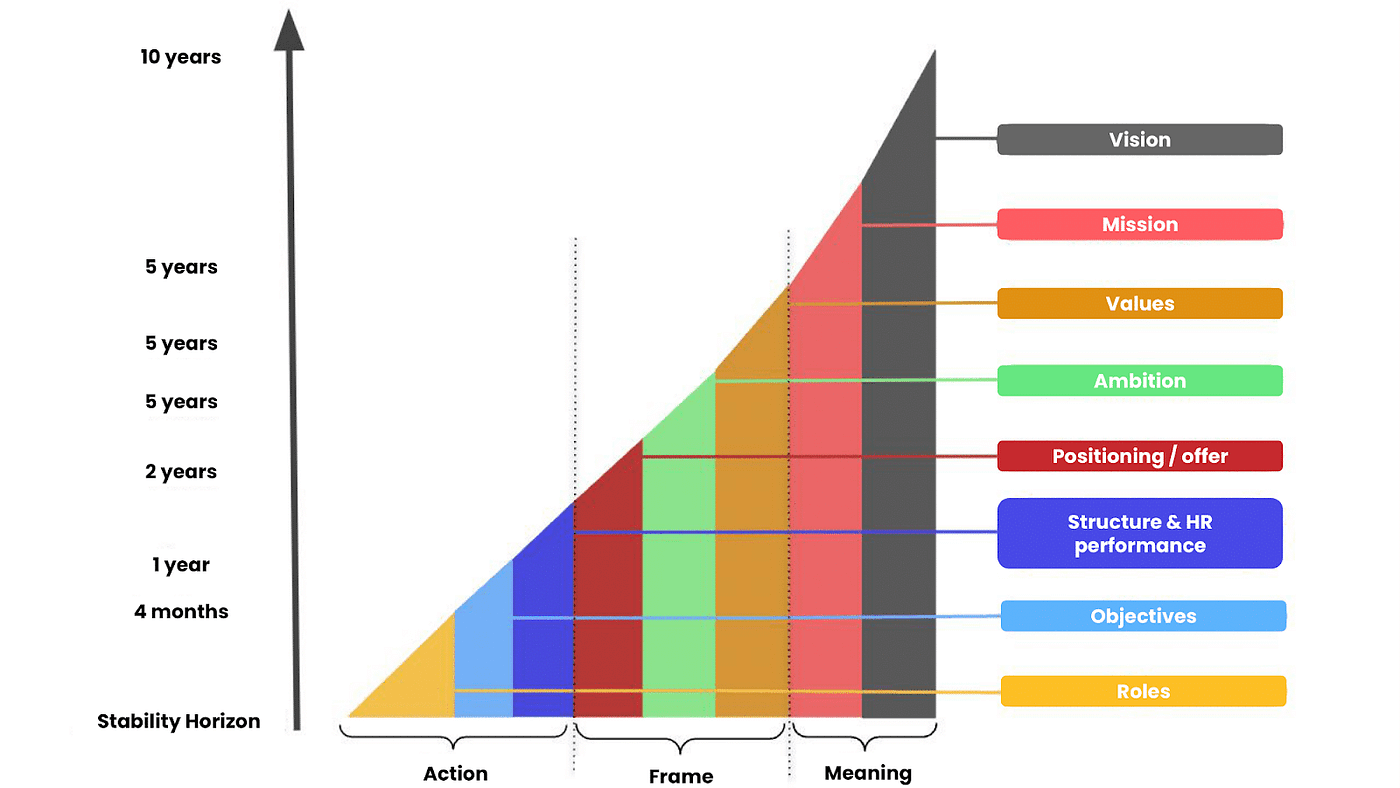
Each participant places a green sticker (“okay for me”) or a red sticker (“not clear, needs to be reworked”) next to each level of the proposed pyramid.
Everyone can share their own definition of the levels and what they believe should be prioritized to realign the company.
For example, if there are five red stickers on the values, you will immediately know what needs to be prioritized.
Disclaimer: Just because there are stickers doesn’t mean the exercise is easy.
3. Challenges and pitfalls of an ExCom and how to overcome them!
Once we have outlined what an ExCom should look like in an ideal scenario, its “visible” side (rituals, decision-making processes, members, etc.), it’s interesting to look at everything that remains unsaid, everything that is “invisible.”
In the invisible realm, we have often encountered the following situations, which are quite common but deserve to be taken seriously to be acknowledged and addressed:
Complexity #1: Who enters and exits the ExCom?
We see people “clinging” to their position in the ExCom, feeling stuck in their role because they don’t dare to step out for fear of being excluded from the ExCom with a change in scope. It is quite healthy to regularly check that everyone feels comfortable and useful in their role, and that their presence makes sense.
We aim to have roles in the ExCom, not individuals.
Example: During a scaling phase, a “head of product” might assume they will take on the role of CPO, even though they may not have the capacity to grow with the organization. The “head of” could participate in the steering/operations committee, but not necessarily the future ExCom.
✅ Solutions
Wait until the product-market fit is well established before setting up the ExCom to avoid frustrations and misallocated roles. Clarify the purpose and intention of the ExCom.
Demystify the ExCom position; it is not an end in itself. Other roles are crucial and require decision-making. Being part of the ExCom is often a goal for an employee, but first, let’s analyze the real added value of each person. A strong ExCom is essential for driving growth.
Let’s not confuse reward with merit, and let’s separate emotions from foundations.
Complexity #2: Lack of alignment
A team that works well individually, i.e., each member with their own teams, but where trust is superficial: updates on project progress are given, OKRs are reviewed, but ultimately, “the CTO struggles to defend the CPO’s choices, and the CRO finds it hard to work with the CMO because there are never enough qualified leads for their sales team.” In short, differences are trivialized, and silos begin to form.
✅ Solutions
When a strategic decision is made, ensure that the level of “buy-in” from the rest of the ExCom is at least without detractors. If there are any, rework the decision until other members are neutral or supportive. This rework can be done collectively or individually and requires a time for honest dialogue where each person can express their level of agreement and what they need. If there is a need to settle unresolved disagreements between two members, it is up to the CEO to make the decision! (Get support from your board or an external mediator/coach if necessary!)
Complexity #3: A challenging balance between strategy and operations!
Some ExComs are disconnected from the field, indulging in discussions about strategy and decisions while gradually losing touch with the day-to-day, the teams, and what’s happening on the client side. On the other hand, some struggle to move beyond operational tasks, focusing exclusively on short-term management. Striking the right balance between solving current issues and creating a desirable and economically viable future is a significant challenge!
✅ Solutions:
During the scaling phase or in large companies, adopting lean management can be a deliberate choice. It allows for the regular review of client KPIs each week (to be defined based on the business, of course, but examples might include churn, NPS, repeat purchases, complaints, etc.).
This approach ensures there is still time to discuss other matters, including medium- and long-term strategies!
In addition to these weekly rituals, offsite retreats (at least twice a year) are the ideal setting for in-depth exploration of long-term topics, gathering opinions and insights, reflecting on the past months, progressing together, and building trust.
Creating an agenda for each of these sessions in advance helps control the topics addressed and allows for focused time (either strategic or operational) to ensure structure and efficiency.
Complexity #4: An ExCom at multiple speeds!
Some ExComs have worked together for so long and know each other so well that they have developed close bonds, which can lead them to protect each other and avoid speaking frankly. There are ExComs with both old members and new ones. There are “support” teams and “business” teams; in short, there are different speeds! This is a reality that cannot be denied, but it can be counterproductive if not clarified and addressed. The ExCom is a system, and therefore, whenever someone new joins or leaves, a new system is created: resetting this new system ensures overall cohesion.
✅ Solutions
Relationships are what they are! Nevertheless, it is the role of the CEO or Chief of Staff to ensure that everyone receives the same level of information to maintain alignment.
Organize cohesion-building moments to develop relationships of trust and authenticity (ExCom dinners, coaching workshops, etc.).
Provide opportunities for feedback to express concerns: it’s okay to disagree, but space must be provided for everyone to express when they disagree. Once this exchange has been allowed and everyone has shared their views, a decision must be made and followed by all.
Feed = nourish, Back = in return; anything that does not nourish in return is not feedback
In conclusion: The 10 golden rules of the ExCom 🥇
- Do not rush to create your ExCom.
- The organization’s functioning is closely linked to the image projected by the ExCom: Be unity, serenity, collective intelligence, engagement, pleasure, and boldness to inspire the organization.
- The ExCom should consist of roles, not individuals.
- Collective interest before individual interest: the ExCom protects the company, and everyone must act for the company. “Ego-first” people are out!
- There is a shared responsibility for the objectives set by different ExCom members: each member is not responsible solely for their own objectives. They are not individual contributors!
- Establish rituals and a structure… and ensure they are followed by someone responsible for their smooth operation (the CEO’s right hand? Chief of Staff, or COO? It depends on the inclination and skills — why not a rotating role?).
- Strategy and execution: find the right balance; strategy is tackled twice a year during offsite retreats.
- It is such a fragile and important body that dedicating time to it and seeking support is not a luxury (ExCom coaching, seminars with external facilitators, etc.).
- Demystify the ExCom while making some decisions visible and understandable to the organization by acting as an “elevator” (bringing up key information from the field and conveying decisions made downwards).
- The choice of individuals is crucial: avoid the passive, those with an opinion on everything, those who are incapable of listening, and those who do not dare express their disagreements. Don’t hesitate to make your hires based on your values!


