Nail your first press announcement
Getting your first press announcement right takes preparation, the right contacts, and a clear strategy. This guide walks through every stage -- from building your press plan six weeks out to following up after launch day -- so your news reaches the right journalists and publications at the right time.
Preparing your first media announcement...
With today's dynamic, fast-paced media, getting your message out there and heard is no easy task. Journalists receive hundreds of emails a day from hungry entrepreneurs desperate for news coverage which makes it hard to stand out, especially if your company or product is not yet (!) famous.
Despite these challenges, and depending on the newsworthiness of your announcement (we'll get into this later), there are a few things you can do to ensure that your message is relayed by the media and other online publications.
This step-by-step guide is designed to accompany you through the different stages involved in preparing for your first press announcement and making it a success.
What Does a Press Announcement Plan Cover?
Agenda
- Getting ready -- A. The Press plan / B. The Social Media plan
- Launch day -- A. Ace your interviews / B. Get your network involved
- Follow up -- A. Keeping up the momentum / B. Building on your actions
What Is the Ideal Timeline for a Press Announcement?
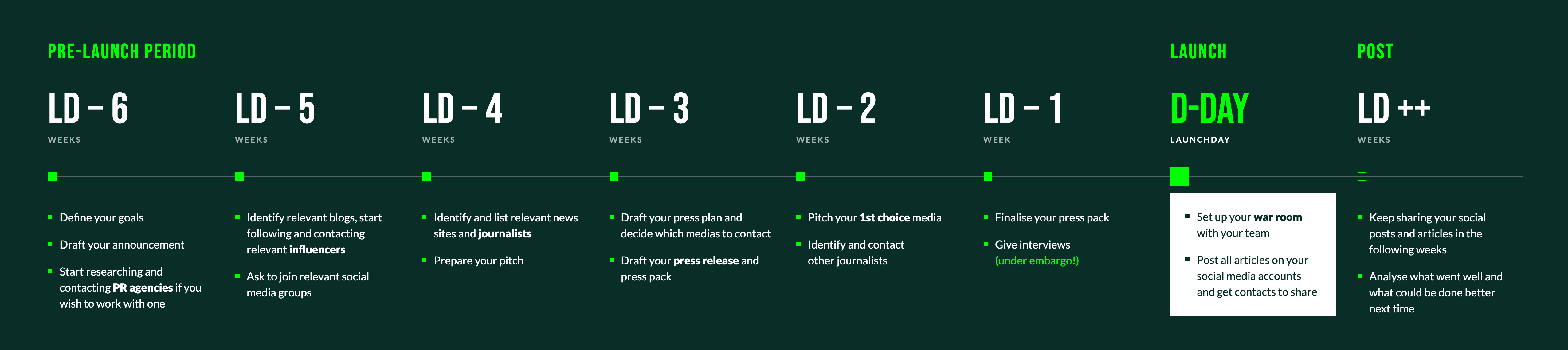
How Do You Build a Press Plan for Your Announcement?
Get your Press Plan ready
Define your goals
Make sure your news is newsworthy/ new and interesting (ex. exclusive market info, user data, a fundraise, a new partnership/client if they are well known, etc). If possible tie your news to a wider narrative, market news or general trend to get better coverage.
Define your goals, what you hope to achieve with the media coverage. This will allow you to better target your audience and the publications you pitch to. For example:
- Customer acquisition: think about your verticals > B2B: Prioritise trade reviews B2C: Target relevant consumer publications
- Increasing investor brand awareness: Target popular tech publications
- Recruiting top talent: Prioritise local and sectorial press, HR mags and student publications
Create your angle
Once you know which publications you're looking to target, craft a story around your announcement that will appeal to their audiences. For example:
- Customer acquisition (trade reviews/ consumer publications) > Provide a customer use-case story with a problem encountered and solved.
- Increasing investor brand awareness (popular tech publications) > Give your story context: provide facts about your market and how your product will impact it. Ask customers to provide interviews/ comments (the more well known, the better)
- Recruiting top talent (local press, HR magazines, student publications) > tell the local press about the local impact of your company, tell them you're hiring. Ask a younger member of your team to talk about working for your company in a HR/student magazine.
Draft your press plan
Once you have your list of publications, your angle and story, then you can make your press plan, who to contact and when. Research your target publications to find out:
- Which journalists cover your sector?
- Their views, styles and preferences?
- When the articles go to press?
- The best time to contact the journalist?
Avoid contacting journalists when they are in editorial meetings or on a deadline! The main reception should be able to advise you on this.
Create a great press pack
This should contain:
- Press release: A short, well-written press release
- Company one-pager: Add to this market context, interesting and relevant facts n' figures, infographics and product screenshots. The document should be 2 pages maxi, attractive and easy-to-read (see example on the next page)
- Social proof: Any previous press mentions or client endorsements
- Brand assets: Company logo
- Founder profiles: Founder photos and short biographies
- Visual assets: Founder, team and product photos and illustrations
- FAQ document: A short FAQ
Establish contact
- Send a short email (3-4 lines) to the journalist introducing the subject and add a couple of interesting facts to pique their interest, follow up with a phone call. Keep a list of which journalists you contact and when
- If you don't have their direct contact details, try contacting them through DM on social media (LinkedIn or twitter)
- Make sure any information sent is marked "Under embargo" with the date and time at which you are ready to share your news, ensuring that it won't be published beforehand.
- Sometimes the journalist will only agree to treat the subject if she/he is given exclusivity meaning they must be the first to publish the news. Other titles will have to respect the embargo (usually 2 hours or so after publication by the chosen media).
Get the Social Media Plan ready
Identify relevant online news sites and blogs
Boost your coverage by sharing your news and articles with different sectoral blogs and newsites.
- Create lists with the URLs of all the publications that write about companies like yours with the help of blog ranking websites such as Alltop, Blogrank and Google News.
- Create a wide list by selecting all categories of publications that are relevant to your companies' activity.
- Use a tool such as Buzz Stream to automatically find corresponding email addresses for each of the publications.
- Send your press kit to each of the email addresses with a short semi personalised and engaging message. The message should contain an introduction, a one sentence pitch and a request (call to action).
Identify and join relevant online Social media groups and databases
Joining online social communities is a great way to broadcast your information to a wider public, create brand awareness and track trends and competitors. Facebook and LinkedIn groups are the most widely used. Use the Facebook and LinkedIn Group Search functions to find relevant groups.
Prepare your social media posts
Prepare several media posts for each of your facebook, Twitter and LinkedIn accounts in advance being careful to adapt the style of each message to the platform.
When each of your online press articles are published, add the links to the different posts and share your news articles.
How Should You Handle Launch Day and Interviews?
Ace Your Interviews on Launch Day
- Prepare your company pitch, keep it short, concise and clear. Practice it to make it sounds as natural as possible. Keep it simple, getting straight to the point. The journalist must understand your product and any pain points you are solving quickly.
- Prepare for your interview by asking yourself what questions the journalist is likely to ask about your company and your market sector.
- Gather together all useful information and key facts and figures on your company and your market in advance. Keep them at your fingertips.
- Put yourself in the journalist's place. What will they find interesting? What will interest their audience? Brainstorm with your team and note any amusing anecdotes or facts that are likely to grab the journalist's attention.
- Try to remain as natural as possible, and to enjoy talking about your company after all, this is an exchange, not an exam!
Get Your Network Involved on Launch Day
- The day of the launch, make sure all hands on are deck and that everyone is prepped with the messages and information they need to share.
- Make sure the whole team participate by sharing the information on their social media accounts.
- Make it fun by adding a little competition. See who can get the most likes and shares for their social media posts and find a little reward or prize for the winner.
Ace your interviews: the Dos and Don'ts list
DOs
- Do prepare and approach your interview from the public's viewpoint.
- Do keep to the facts and keep answers short and to the point.
- Do come across as knowledgeable, confident and honest!
- Do give anecdotes or amusing stories to better illustrate your message.
- Do provide examples and interesting facts and figures.
- Do cite sources when necessary.
- Do conduct phone interviews via landline, unless mobile is absolutely necessary. With a landline, you won't have to worry about a dropped call or poor reception.
- Do dress for the occasion if you're going on TV for an interview. Avoid all white and busy designs with a lot of colour.
DON'Ts
- Don't wing an interview. Remember: practice makes perfect! Have a Q&A session with a colleague and jot down 3/4 key points you'd like to communicate during the interview.
- Don't give impromptu interviews, preparation is key.
- Don't go off the record. Everything you say during an interview can be quoted.
- Don't say "no comment". If you cannot discuss a matter say so and offer the journalist something else.
- Don't go off on tangents. Be concise and try to throw in some soundbites
- Don't speculate or exaggerate. Stick to the facts.
- Don't disparage your competition.
- Don't drop your guard even when the interview is over.
What Should You Do After Your Press Announcement Goes Live?
Keep Up the Momentum
Just because the launch day is over, doesn't mean the hard work stops here!
- Keep track of all articles and social media post that appear in the days and weeks following your announcement. These are your KPIs. Note the posts and sites that had the highest number of impressions and engagements.
- Continue sharing on your social media accounts and don't forget to mention or tag any influencers, journalists or partners so that they can continue to like and share your news.
Build on Your Actions
- Carry out a post mortem after all the fuss has died down and ask yourself and your other team members -- HOW DID IT GO? WHAT WORKED WELL? WHAT COULD BE IMPROVED?
- Write down what you did well and what you could have done differently.
- Stay in touch with the journalists you worked with and drop them a line every now and then to keep them informed on your company's progress.
Frequently Asked Questions
Q: How do you write a press release for a first announcement?
A: A strong first press release is short, well-written, and built around a clear news angle -- such as a fundraise, a partnership, or a product launch. Include a brief company one-pager, relevant facts and figures, founder bios, and a short FAQ. The document should be no longer than two pages and easy to scan.
Q: When is the best time to contact a journalist with a press announcement?
A: Avoid reaching out when journalists are in editorial meetings or working to a deadline. The main reception desk of a publication can usually advise on the best contact windows. A short introductory email (3-4 lines) followed by a phone call tends to be the most effective approach.
Q: What is an embargo in media relations and how does it work?
A: An embargo is an agreement between a company and a journalist that the news will not be published before a specified date and time. Mark all materials sent to press as "Under embargo" with the agreed release date. Some outlets may request exclusivity, meaning they will be the first to publish -- other titles then typically observe a short embargo window of around two hours after initial publication.


